KIRAN L. DHANJAL-ADAMS
  • News
  • Research
  • Publications
  • About me
  • Supervision
  • Contact

Methods for Conservation and Ecology

I am an ecologist, interested in developing
​methodology and theory to inform conservation decisions in a changing world

Priorities for migratory networks

10/11/2016

0 Comments

 
Making good decisions with limited information
This is a post I wrote for Decision Point about my recently accepted paper in Conservation Biology

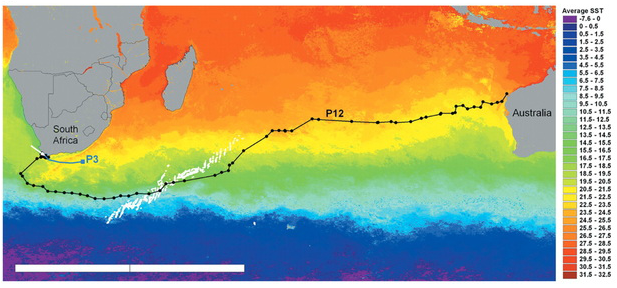
The movie Jaws made great white sharks into world-famous human eaters. Less well-known about great whites is that they can undertake astounding migrations. In 2002, a shark tagged in South Africa was tracked all the way to Western Australia (see Figure 1). Though it lost its tag in Australia, it was re-sighted again in South Africa, proving the species capable of migrating some 20,000 kilometers.
​
Picture
Figure1. Positions of (dots) and track followed by (black line) shark ‘P12’ during coastal and transoceanic movement. (Image from Bonfil et al, 2005.)

​Great whites are, however, far from being alone when it comes to astounding feats of migration. Dragonflies have been found to travel similar distances between India and Africa, stopping off in the Maldives on the way. The longest recorded migration of all is that of an Arctic tern, which flew 70,000 km over a year from one pole to the other and back, in search of an eternal summer.

A lifestyle on the move is not without risk. Migration is physically demanding, and migratory species are highly reliant on places to stop, rest and feed along the way. Unfortunately, human activities are making it riskier for animals to travel, while also reducing the number of places they can travel to. Fishing, culling, fence-building, deforestation, land-reclamation and plastic pollution are all making it increasingly difficult for many species to migrate. So much so, that migratory species populations are declining at much greater rates than nonmigratory species.

This suggests that current conservation strategies are not working as well as we would like them to. We are still at the early stages of understanding migration, and data detailing where, when and how far many species migrate is still sparse. Though a few individuals of some species have been tracked, it remains unclear how these few tracked individuals reflect the migration patterns of an entire species.

What should we measure?

Because of this poor understanding of where animals migrate, conservation strategies are currently set using the data we have – animal counts. Indeed, it is not unreasonable to assume that sites with lots of migrants are probably more useful to the population than sites with fewer migrants.
Picture
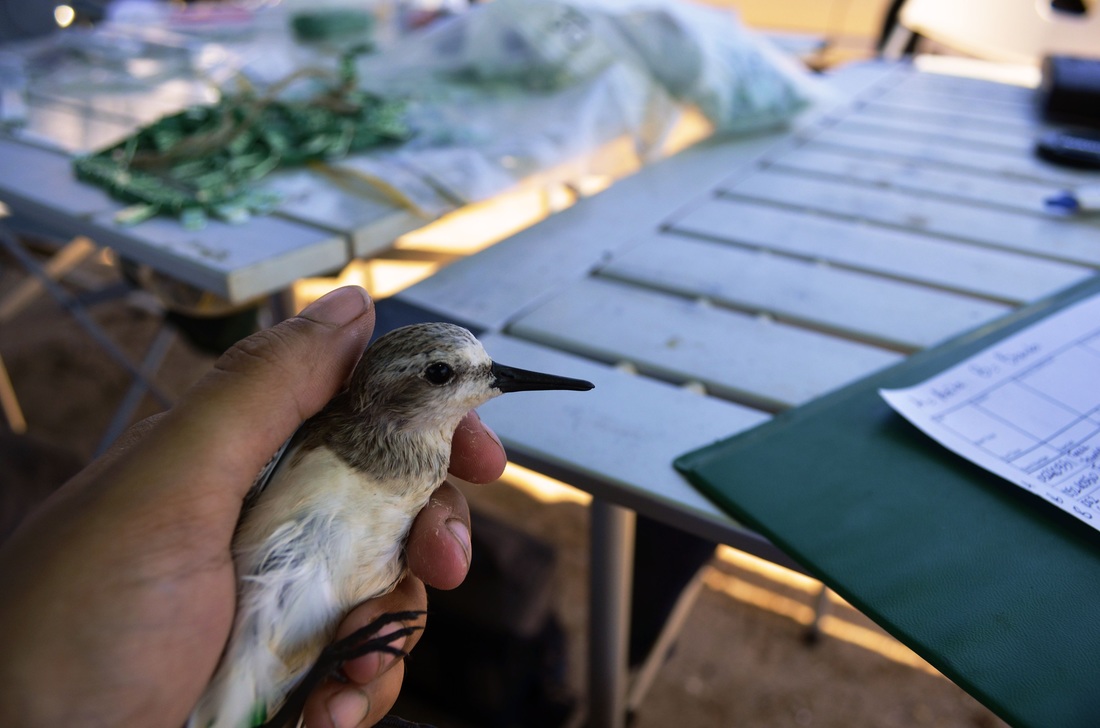
Catching and tagging birds is large part of understanding here they migrate. However, if we tag a few birds in multiple locations, we can learn more about how the population behaves as a whole, than if we tag many birds in the same location. (Photo by Kiran Dhanjal-Adams).

​However, increasingly research is showing that where these sites are relative to each other is equally important. This is because the distance between two sites is likely to impact the number of animals able to travel between the two. Connected sites are therefore more useful to the population than unconnected sites.

So, how do we marry abundance measures with connectivity measures to set conservation priorities for migratory species when so few animals have been tracked? To help maximise the value of limited information, we have developed a methodology for using as few as three tracked individuals to calculate the probability of an animal travelling between any two places (Dhanjal-Adams et al, in press). By augmenting these
measures with count data, it is then easy to draw up the migratory network of a species.

What should we prioritise?


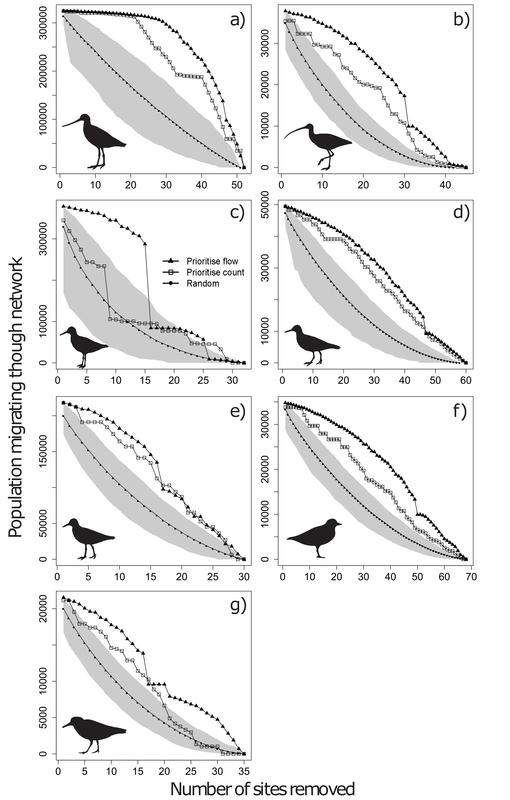
We did this for seven migratory shorebird species in the East Asian-Australasian Flyway. We found that conservation strategies that prioritise sites based on connectivity and abundance together, always outperform strategies that only prioritise sites based on abundance (Fig 2).


Picture
Figure 2: In our study, we drew up a migratory network and removed sites according to different prioritization strategies to see how they influenced population declines. The flow prioritisation strategy (black triangles) includes connectivity data as well as abundance data. The maximum count prioritisation strategy only includes abundance data (squares). The random prioritisation strategy does not include any connectivity data or abundance data, but choses sites at random for conservation. We therefore perform the random prioritisation strategy 1000 times to have a representative spread of possible results (black circles; ±95% quantiles) We compared these three strategies for seven different migratory shorebird species: a) bar-tailed godwit, b) eastern curlew, c) great knot, d) grey-tailed tattler, e) red knot, f) ruddy turnstone and g) sanderling. As you can see, the flow prioritization strategy always outperforms the count prioritization strategy and random prioritisation strategy.

Interestingly, sites with a smaller number of birds can be given a higher conservation priority than sites with lots of birds. This is because groupings of small sites can act as a unit, which together, support a higher proportion of the population than an isolated site with a higher bird count. These groupings of small sites are therefore prioritized over the site with slightly more birds. However, these tradeoffs are complex and difficult to predict, making it important to draw up a migratory network during the planning process.

By using very simple metrics, we show that it is possible, despite a lack of tracking data, to come up with estimates of where migratory species might travel, which in turn can be used to inform conservation planning.

Importantly, given migratory species are declining despite the current protection, methods like the one we have developed can be used to determine the value of adding additional habitat to the current network of protected areas.​
0 Comments


Leave a Reply.

    Kiran L. Dhanjal-Adams

    All views expressed are my own.

    Archives

    July 2025
    November 2024
    March 2023
    January 2020
    September 2019
    November 2018
    August 2017
    October 2016
    July 2016
    May 2016

    Categories

    All

    RSS Feed

Powered by Create your own unique website with customizable templates.
  • News
  • Research
  • Publications
  • About me
  • Supervision
  • Contact