Methods for Conservation and Ecology
I am an ecologist, interested in developing
methodology and theory to inform conservation decisions in a changing world
|
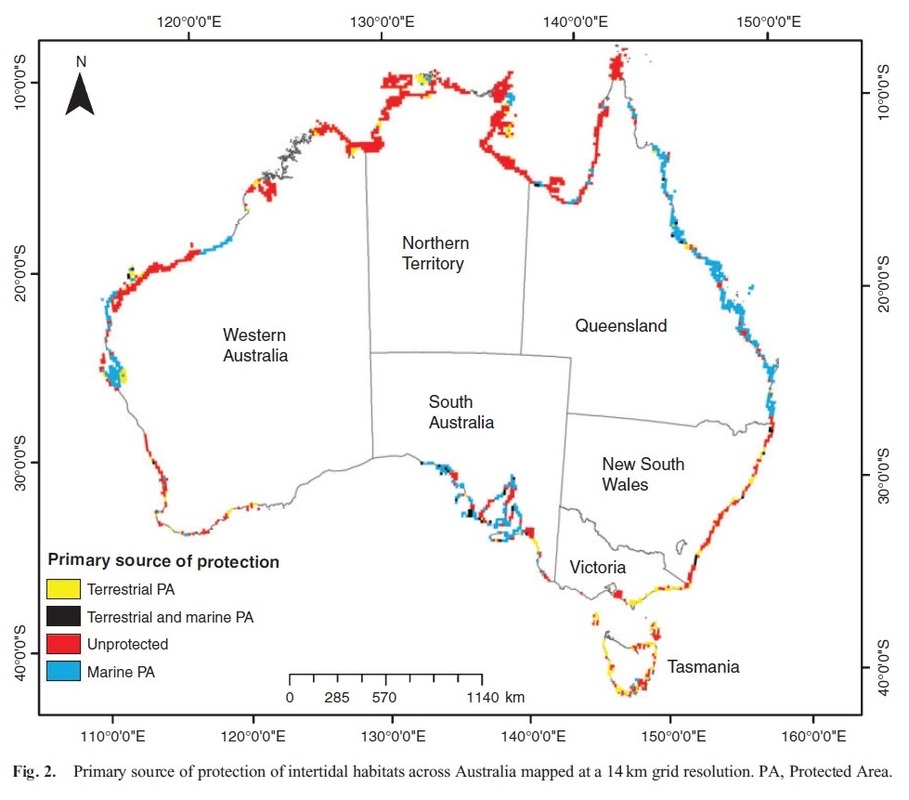
Mapping the distribution and protection of intertidal habitats in Australia Somewhere between land and sea lie intertidal habitats such as sandflats, mudflats and rocky reefs. These in-between places provide a wide range of valuable services including fisheries, recreation, buffers to sea-level rise and storm protection. Yet the distribution of these habitats, and therefore how well they are protected in reserves, remain unknown at a national level, below a 10km resolution. Of course, mapping the distribution of a habitat which is repeatedly inundated can be remarkably complex, even using remote sensing. That’s a big part of the reason we know so little about the distribution of these habitats. With Landsat imagery for example, images (which are taken only every 16 days) must coincide with the highest and lowest astronomical tides on a day without cloud, to create a map. Finding suitable images at a national level is therefore difficult, but not impossible. In our study, we were able to combine 15 years of images to produce the first map of intertidal habitats for Australia at a 30m resolution (the shapefile can be found at https://doi.pangaea.de/10.1594/PANGAEA.845726) (Dhanjal-Adams et al, 2016). The method we used to map the extent and distribution of intertidal habitats in Australia was based on a continental-scale mapping project conducted across Asia by Nick Murray and colleagues (Murray et al, 2012; and see Decision Point #81). Of the 9,856 km2 of mapped habitat, we discovered large intertidal areas, particularly in Western Australia, Queensland and South Australia, along embayed coastlines and river mouths. Furthermore, we discovered that 39% of mapped intertidal habitats fell under the jurisdiction of one protected area designation or another (fig. 2). Levels of protection varied considerably between states ranging from 80% in Victoria to 6% in the Northern Territory. We were also surprised to discover that some states mainly protected intertidal habitats as part of marine protected areas (eg, Queensland), and others as part of terrestrial protected areas (eg, Victoria). In some cases, 3% intertidal habitats were protected both by marine and a terrestrial protected areas (10% in South Australia). Given the importance of intertidal habitats, there is a strong need to better understand how these designations can impact management of intertidal species. Intuitively, we might expect such designations to lead to better protection with both marine and terrestrial protected area managers collaborating. However, there is also the potential for confusion, with neither organisation sure who should take the burden of responsibility. The protection of intertidal habitats is undeniably blurred, but with great potential for improvement. By providing the most accurate map of intertidal habitats to date, our research provides the data needed to better align protected area boundaries with intertidal habitats. In so doing we can improve the protection afforded to the many amazing species these habitats support.
4 Comments
|
Kiran L. Dhanjal-AdamsAll views expressed are my own. Archives
July 2025
Categories |